There are stereotypes associated with both with bringing a lunch from home, as well as buying school lunch. However, the stigmas with buying lunch from school are generally more negative. This can greatly affect students and their social systems in school.
The Lunchroom Environment:
- “lunch was the only everyday whole-school affair. It had symbolic significance, exhibiting that fully public regional high school’s hidden curriculum” (Laird 18).
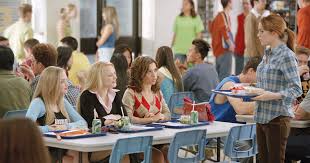
- What lunch table one sits at, especially at high schools, can directly affect their social situation in school.
- Typical lunchroom may not exactly have only specific cliques at each table, but it follows this pattern. There is a type of segregation in groups of people.
- People who bring lunch from home get to sit down first, while others have to wait. This can cause those who bring lunch to sit with others who did in order to not be alone.
- This feeds into the stereotype that those who buy lunch are poorer. If that is true, then those students have less time to spend with friends to sit and eat and are more likely to be excluded from certain lunch tables because they did not get there on time and there was no space for them left.
- Poppendick says this adds to the stereotype that the kids who are not cool eat the gross cafeteria food (194).
- This can also be racially seperated because certain races are more likely to buy lunch versus bring their own. This reinforces other socially constructed boundaries; for example, people are more likely to sit with people the same race as them.
- Laird explains that schools’ lunch systems have contributed directly to a “racial caste’s redesign as the New Jim Crow” ( 22)
- Social and racial stereotypes can be affected by whether one brings their lunch or not.
School Lunch is for the Poor?:
- Stereotype that the kids who get school lunch are the free kids “marked as poor” (Poppendieck 190).
- Poppendieck explains how one student was eligible for school lunch, but was embarrassed annoyed mom for money (263).
- This is more obvious in school districts that include a diverse range of students, or students coming from both wealthy and poor areas. For example, a school district that covers both residences in the suburbs and inner city, will have a greater diversification of students. This makes the social divide more prevalent and obvious.
- This stigma is less prevent with younger, elementary school students. This is probably because they either do not care how much money their peers’ families make or because they do not fully understand it (Poppendieck 191).
- However the type of stigma elementary school students are more likely to care about is marked with consumerism. Younger students are more likely to pay attention to what type of lunch box one brings and how “cool” it is. Obviously one with a superhero on it is going to be more appealing than just a brown paper bag. That is why markets have played into making lunch boxes appealing to students. This is directly linked to consumerism, but also plays into wealth because those with nicer lunch boxes are seen as more affluent.
- Also, younger students are more willing to trade their lunch food items (Poppendieck 191).
- Certain brands are more desirable for students to trade, which shows materialism. Also students would rather trade with others who brought their lunch, which places a burden on those who buy it from school and adds to the negative stereotype.
 Packed School Lunch in America