Sources

Au, Lauren E., et al. “Eating School Lunch Is Associated with Higher Diet Quality among Elementary School Students.” Journal of the Academy of Nutrition and Dietetics, vol. 116, no. 11, 2016, pp. 1817–1824., doi:10.1016/j.jand.2016.04.010.

Bjornlund, Lydia. How the Refrigerator Changed History. Essential Library, an Imprint of Abdo Publishing, 2016.

Buchholz, Gertrude. 300 Helpful Suggestions for Your Victory Lunch Box: How to Plan, Prepare and Pack a Compact and Nutritious Meal for Factory, Office or School. Dell Pub. Co., 1943.

Caruso ML, Cullen KW. Quality and Cost of Student Lunches Brought From Home. JAMA Pediatr.2015;169(1):86–90. doi:https://doi.org/10.1001/jamapediatrics.2014.2220

Farris, Alisha R., et al. “A Comparison of Fruits, Vegetables, Sugar-Sweetened Beverages, and Desserts in the Packed Lunches of Elementary School Children.” Childhood Obesity, vol. 11, no. 3, 2015, pp. 275–280., doi:10.1089/chi.2014.0134.

Laird, Susan. “School Lunch Matters: Encountering the New Jim Crow and the Anthropocene.” Educational Studies, vol. 54, no. 1, Feb. 2018, pp. 17–33., doi:10.1080/00131946.2017.1407937.

Park, Mary. The School Lunch. University of Illinois, College of Agriculture, Extension Service in Agriculture and Home Economics, 1921.

Poppendieck, Janet. Free for All: Fixing School Food in America. University of California Press, 2010.

Smith, S., & Cunningham-Sabo, L. (2014). Food choice, plate waste and nutrient intake of elementary- and middle-school students participating in the US National School Lunch Program. Public Health Nutrition,17(6), 1255-1263. doi:10.1017/S1368980013001894

Photo Sources:

Arzamasova, Nataliya. fr.123rf.com/photo_42739540_boîtes-à-lunch-de-l-école-pour-fille-et-garçon-avec-de-la-nourriture-sous-forme-de-grimaces.html.

“Childhood Obesity: Current and Novel Approaches.” Childhood Obesity: Current and Novel Approaches, 2015, http://www.sciencedirect.com/science/article/pii/S1521690X15000263.

“Cost Effective Lunchables!” Cost Effective Lunchables!, thecsiproject.com/2011/08/30/cost-effective-lunchableschoose-to-thrive/.

“Dr. Damon Korb Urges Parents To Stop Packing School Lunches For Children Once They Have Become EIGHT.” Dr. Damon Korb Urges Parents To Stop Packing School Lunches For Children Once They Have Become EIGHT, 8 Oct. 2019, whatsnew2day.com/dr-damon-korb-urges-parents-to-stop-packing-school-lunches-for-children-once-they-have-become-eight.

“Extent and Consequences of Childhood Obesity.” Extent and Consequences of Childhood Obesity, 2005, http://www.nap.edu/read/11015/chapter/4.

“Feature Series: Reducing and Managing School Cafeteria Food Waste.” Feature Series: Reducing and Managing School Cafeteria Food Waste, 12 June 2019, healthy-food-choices-in-schools.extension.org/feature-series-reducing-and-managing-school-cafeteria-food-waste/.

“How Does Mean Girls’ Most Iconic Scene Hold Up Today? We Asked 5 Real Teens.” How Does Mean Girls’ Most Iconic Scene Hold Up Today? We Asked 5 Real Teens, http://www.refinery29.com/en-us/2019/04/230395/mean-girls-cafeteria-map-cliques-racist-stereotypes.

“MyPlate Guide To School Lunch.” MyPlate Guide To School Lunch, http://www.fns.usda.gov/tn/myplate-guide-school-lunch.

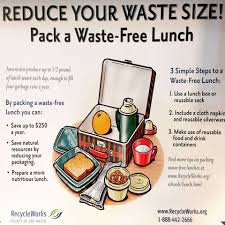
“Reduce Your Waste Size!” Reduce Your Waste Size!, http://www.pinterest.com/pin/145030050477021893/?lp=true.

Watson, Julia. “Percent of Children Eligible for Free or Reduced Price Lunch By County ( 2014 to 2015).” Percent of Children Eligible for Free or Reduced Price Lunch By County ( 2014 to 2015), communitymappingforhealthequity.org/map-of-the-day/percent-of-children-eligible-for-free-or-reduced-price-lunch-by-county-2014-to-2015/.
Survey: Fieldwork

Background:

This survey was passed out to 9th- 12th graders a Lafayette High School, Jamestown High School, and Warhill High School in Williamsburg VA. The purpose of choosing these schools was to see if the patterns found nationally dealing with school lunch made sense. I received 276 responses back. It was from a convince sample, taking place during the students lunch period.

Results:


Question
PackBuyBoth
Do you pack or buy your lunch? 
136/276~49%56/276~20%84/276~30%
What is the average daily cost of your lunch. If you’re not sure estimate it.

$5.35
$2.25$4.80
On a scale of 1-10 how healthy would you rate your average lunch, 10 being the healthiest and 1 being the unhealthiest ?
6.2
4.1
5.5
How many times a week on average do you have a fruit with your school lunch? (0-5)
3.94.24.3
How many times a week on average do you have a vegetable with your school lunch? (0-5)
1.82.62.4
Do you think lunches packed from home are healthier? ( answer is the percent who said yes)130/136~96%54/56~96%77/84~92%
On a scale of 1-10 how often are you able to find options you want to eat in the school lunch line, 10 being always, 1 being never.N/A6.94.5
If you bring your lunch, who prepares it?Myself: 98/136Mom: 37/136Dad:1/138N/AMyself: 68/84Mom:16/84
What percent of your lunch do you estimate you throw away on average a day. 14%26%20%

  1. What are some stereotypes about school lunch? (open ended question)

Most common answers:

  •  It tastes bad 68% of students
  • It is unhealthy 38% of students
  • It is cheap 18% of students 

Key Takeaways:

  • The majority of students seem to bring their lunch to school, at least sometimes.
  • Students estimated their lunch was more expensive if it was packed than those estimates from students who buy
  • Students who pack their lunch seem to think it is healthier than those who buy, however students who buy lunch have higher averages of their lunch containing both fruit and vegetables
  • Students have fruit more often a week with their lunch than vegetables, regardless of if they pack or buy lunch
  • Both students who pack, and who buy their lunch overwhelmingly believe packing school lunches is healthier
  • Students who buy their lunch everyday are more able to find something they want to eat in the lunch line, compared to students who both pack and buy their lunches. 
  • Most students pack their own lunch, but if they don’t it would most likely be their mom packing it. This probably varies greatly from elementary school students who are not old enough to pack lunch yet.
  • Students to buy their lunch estimate to throw away more of their food.
  • The most written serotypes with school lunch are all negative

Food Waste

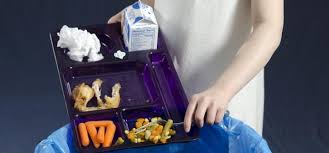
Food waste can be a huge problem when it comes to school lunches in America. Students may have no regard for the effects that come with wasting their lunch. However there are both benefits and disadvantages to bringing a lunch from home, when it comes to food waste.

Background

  •  On average, elementary school students consumed 85.1% of total energy provided in packed lunches (Caruso, Cullen 88)
  • “I saw a lot of uneaten food go into lunchroom trash barrels” (laird 18) – The food wasted more likely comes from school provided lunches due to statistics
  • Elementary-school students wasted more than a third of grain, fruit and vegetable menu items. Middle-school students left nearly 50 % of fresh fruit, 37 % of canned fruit and nearly a third of vegetables unconsumed (Smith, Cunningham 1259)
  1. Leftovers
  • By packing a lunch with leftovers from home the day before students are saving food that otherwise might have been wasted. 
  • “left-overs of chops or roasts which may be ground and made into sandwiches” (Buchholz 6)
  • This also adds to cost efficiency because families will save more money by still eating leftover food, if they accidently overestimate how much they’ll need before.
  • If students aren’t hungry enough to eat their whole lunch one day, instead of throwing it away they can bring it back home in their lunch box and eat it another day, or another family member can. This is harder for those who buy lunch because it is less likely they will have a container to bring the food they do not want home. This leads to them just throwing it away because it is easier to do so.
  1.  Timesaver
  • Although packing a school lunch may take excess time at home in the morning, or the night before, it saves students time during the lunch period. This is because they do not have to wait in the school lunch line, and instead, can start eating at the beginning of the lunch period.
  • Poppendieck explained how a child asked to bring lunch because she did not have enough time to eat the school provided lunches. (149)
  • Not having enough time to eat lunch can lead to more being thrown away. Less time to eat = More food waste
  • Bringing a lunch prevents time being cut away from lunch periods, so slow eaters have more time to eat their food, instead of being forced to dispose of the food they did not finish in time
  1. Choice Matters
  • “students’ often-observed disposition to throw away, rather than eat, what schools feed them poses a persistent challenge to school lunch administrators, so taste invokes choice matters” (Laird 27)
  • Packing a school lunch from home, usually gives students more of a choice of what to being. Bringing food they like means they are more likely to eat it and it won’t go to waste as much as choosing from limited school options. 

Choice Ability:

Overall, there is much more choice ability when students bring their lunches from home rather than buying school lunch. This can lead to various other benefits I’ve discussed like less student satisfaction, less food waste, healthier options, and education. The opposite can be said to be true when bringing a lunch, but giving students and families a greater CHOICE gives them the ability to prevent this if they choose to. 

Student Satisfaction: 

  • “To avoid monotony, the lunch box menu should be varied from day to day. And remember that the right combination of colors, flavors and textures is important in every meal, both at home and one abroad”(Buccholtz 6).
  • It depends if parents give students a say in what gets put in their lunch from home or not, but usually they get to choose food they are more willing to eat. This leads to students being happier with their lunch meals.
  •  “The idea is not only to pack a wholesome, nutritious lunch but one that will be enjoyed—ond therefore will be eaten to the last crumb.” (Buchholtz 5)
  • “The only lunch-line choices were yes and no.” (Laird 18)
  • In school lunch lines there is a limit on the types of food available, so it is hard to satisfy picky eaters. 

Food Waste:

  • Students are less likely to waste food if they get to choose what is in their lunch.
  • Laird explains that choice matters when it comes to food waste because students are given limited options in lunch lines, and sometimes are even forced to put certain foods on their plate (27).
  •  This explains the higher waste rates of vegetables, that school systems are forced to put on students plates to promote healthy eating, are being thrown away (Smith, Cunningham 1260).
  • However, parents can still purposely add healthy items to their children’s lunch boxes, which their kids don’t like. This can lead to them throwing away these food items to make it look like they ate them and make their parents happy.

Healthier options:

  • Laird explains that while a school community  “boasted fertile family farms, organic gardens, food coops, creative cooks, and international ethnicities galore,” their most popular school lunch item called a “pizza bagel, neither Kosher nor vegetarian, always topped with a very few hamburger crumbles or a slice of pepperoni on top of the cheese.” (18)  This may not be the case everywhere, but is for many school systems.
  • When packing a lunch from home, students can have a greater variety of options to choose from and, if they eat healthy at home, they can continue this at school.
  • On the other hand, if students come from households that are full of junk food, or are more impoverished, they may have less healthy options. This will then carry over to their lunch at school and have a negative effect. 
  • “Girls and boys are building the physical houses in which they are to live. If, like some carpenters, they select a poor grade of material, or all one type of material, they will not have strong, useful buildings” (Park 6)

Education

  • Giving students the choice to pick their items, not only allows them to eat healthier, but teaches them to continue making smart choices for their health. 
  • Laird says, “In that deliberation lies its educational value, of course, for choosing involves reflection upon values; it requires knowledge of options and substantial information about them; it requires developing self-knowledge and cultural sensitivity” (25-26).

Stereotypes/Stigmas:

There are stereotypes associated with both with bringing a lunch from home, as well as buying school lunch. However, the stigmas with buying lunch from school are generally more negative. This can greatly affect students and their social systems in school. 

The Lunchroom Environment: 

  • “lunch was the only everyday whole-school affair. It had symbolic significance, exhibiting that fully public regional high school’s hidden curriculum” (Laird 18).
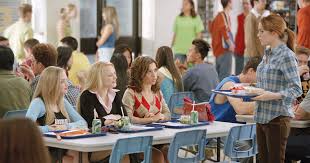
  • What lunch table one sits at, especially at high schools, can directly affect their social situation in school.
  • Typical lunchroom may not exactly have only specific cliques at each table, but it follows this pattern. There is a type of segregation in groups of people. 
  • People who bring lunch from home get to sit down first, while others have to wait. This can cause those who bring lunch to sit with others who did in order to not be alone. 
  • This feeds into the stereotype that those who buy lunch are poorer. If that is true, then those students have less time to spend with friends to sit and eat and are more likely to be excluded from certain lunch tables because they did not get there on time and there was no space for them left. 
  • Poppendick says this adds to the stereotype that the kids who are not cool eat the gross cafeteria food (194).
  • This can also be racially seperated because certain races are more likely to buy lunch versus bring their own. This reinforces other socially constructed boundaries; for example, people are more likely to sit with people the same race as them.
  • Laird explains that schools’ lunch systems  have contributed directly to a “racial caste’s redesign as the New Jim Crow” ( 22)
  • Social and racial stereotypes can be affected by whether one  brings their lunch or not.

School Lunch is for the Poor?:

  • Stereotype that the kids who get school lunch are the free kids  “marked as poor” (Poppendieck 190).
  • Poppendieck explains how one student was eligible for school lunch, but was embarrassed annoyed mom for money (263).
  • This is more obvious in school districts that include a diverse range of students, or students coming from both wealthy and poor areas. For example, a school district that covers both residences in the suburbs and inner city, will have a greater diversification of students. This makes the social divide more prevalent and obvious. 
  • This stigma is less prevent with younger, elementary school students. This is probably because they either do not care how much money their peers’ families make or because they do not fully understand it (Poppendieck 191).
  • However the type of stigma elementary school students are more likely to care about is marked with consumerism. Younger students are more likely to pay attention to what type of lunch box one brings and how “cool” it is. Obviously one with a superhero on it is going to be more appealing than just a brown paper bag. That is why markets have played into making lunch boxes appealing to students. This is directly linked to consumerism, but also plays into wealth because those with nicer lunch boxes are seen as more affluent.
  • Also, younger students are more willing to trade their lunch food items (Poppendieck 191).
  • Certain brands are more desirable for students to trade, which shows materialism. Also students would rather trade with others who brought their lunch, which places a burden on those who buy it from school and adds to the negative stereotype. 

Gender Roles:

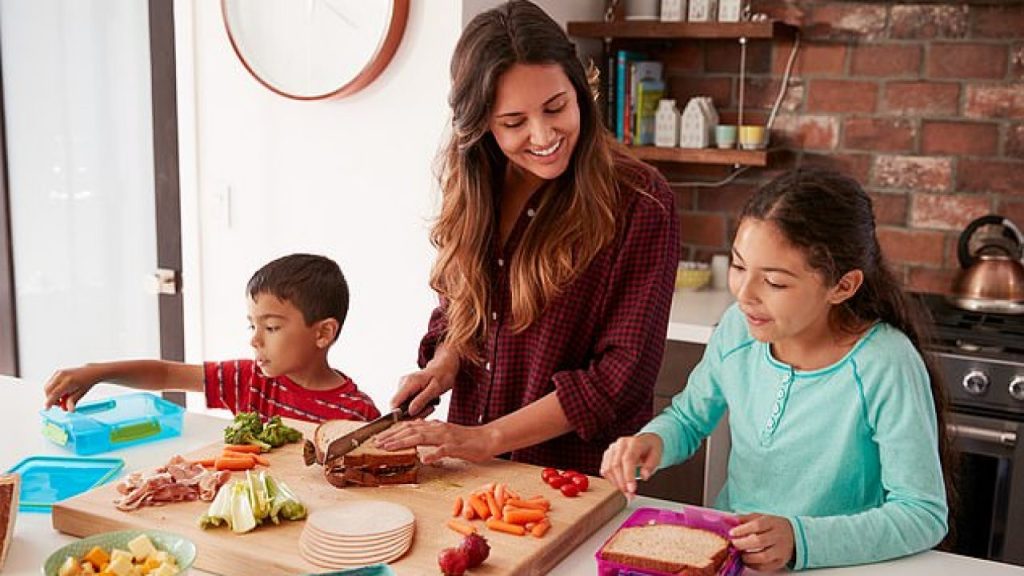
Gender roles come into play for both who prepares children’s school lunches as well for who is eating them. It is usually women who prepare school lunches, which is a trend that has not changed since the rise of bagged lunches over a century ago. Also, there are certain stereotypes in what type of food should be given for girls for lunch verus for boys.   

Who’s making the lunch:

  • In the past (1940s), much responsibility was put on mothers to make their children, and husbands acceptable lunches to bring to work and school.
  • “Planning and packing good lunches day after day should be looked upon as something of a challenge. If you don’t meet it with initiative and enthusiasm, the members of your family will be eating hastily-put-together and unsatisfactory meals instead of the wholesome lunches they need for good health and morale” (Buchholtz 4).
  • Buchholtz explains how it was their duty and if did not succeed at planning and preparing good, nutritious lunches their whole family would suffer (4). 
  • Park, who wrote in the 1920s, explains the negatives of this burden being placed on women. She writes “Many mothers have not had an opportunity to study food values. They are anxious to give their children the very best, but lack of knowledge along this line makes it diflicult” (6). Park emphasizes that regardless, women should have the time and knowledge to pack a simple lunch that isn’t monotonous or unappetizing (11).
  • It is interesting that although women’s rights have increased and gender stereotypes have decreased, that women are still usually the ones packing bagged lunches. Also, since more women are in the workforce this can be more difficult for them to do because it is another thing to take up their time. This can lead to lazily packed lunches, or even an increase in buying school lunch because it is more convenient. 

Who’s eating the lunch:

  • There are various preconceived notions of the types and amount of food women versus men should eat and this can start with children at a young age. 
  • Although it is true that grown men should be consuming more calories than women, this wouldn’t be the case for younger students, but because of the stereotype, mothers have packed more for their sons than daughters.
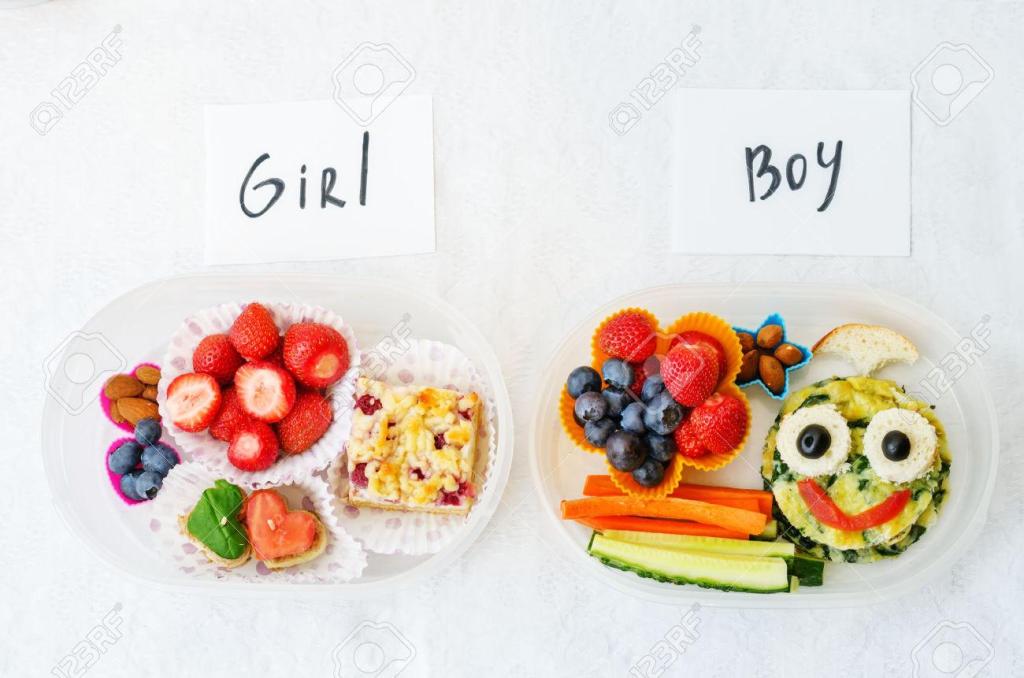
  • Furthermore, the types of food that girls versus boys “should” eat, differ.
  • “Teen-age girls and women office workers like dointier foods and are interested more in variety than are boys and men —whose preferences run to substantial food, and plenty of it”  (Buchholtz 5). Buchholtz encourages mothers reading to pack lunces according to these ideas (5). 
  • While this is not as common today, girls sometimes still get shortchanged on the food their mothers pack them for school.
  • However, this also correlates to food waste and what gender contributes most to it.

Health:

Food is one of the biggest components of one’s health, and is even more important for children because they are still developing. That is why school lunch plays a huge part in student’s health and bringing lunch can have different effects from buying lunch. 

Comparison:

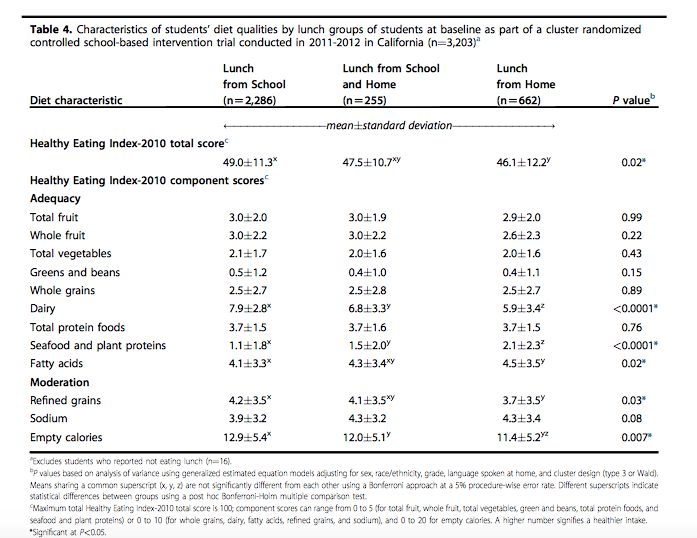
  • Au’s Study Results
    •   showed that students who ate breakfast and lunch from school consumed diets higher in dairy-rich foods while limiting calories from solid fats and added sugars, compared with students eating meals from home (1823).
    • eating school meals was not associated with differences in intakes of vegetables and whole grains compared with eating meals from home (1823).
    • on average, all students achieved about half of the maximum diet quality score, which shows  the need for improvement for all students, regardless of where their meals come from (1823)
  • Farris’s Study Results
    • “Nearly two thirds of the packed lunches contained at least one dessert item, and approximately one fifth of those lunches contained two dessert items, which contributed to increased levels of energy, fat, saturated fat, and sugar, compared to lunches that did not contain dessert” (279).
    • Rougly 42% of packed lunches did not contain a fruit or vegetable (278).
    • Only 12.5% of lunches packed both a fruit and vegetable (278).
    • Rougly 59% of packed lunches did not contain a sugar sweetened beverage (278). 
  • However, students or families that choose not to eat school made lunch on nutritional grounds- not money or convenience – are much healthier than those who do for those purposes (Poppendieck 142).  
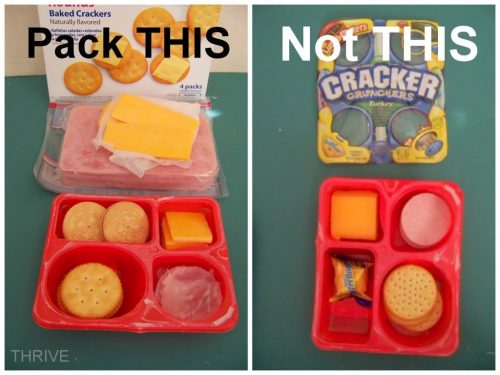
  • If the packer of lunch’s goal is to make it healthy, than it will be. On the other hand if they pack lunch to save money, it may not be as healthy because generally healthier foods are more expensive. Also, if their goal is just convenience they may not take the time to plan something healthy and just throw pre-packaged food in the lunch, instead of things like fresh foot at vegetables. 
  • This shows that packing school lunch is what one makes of it, but in general tends to be less healthy than school provided lunches due to school policies,

Au’s Study chart

School Policy: 

  • “National School Lunch Program (NSLP) was established in 1946—ever since then, the primary source of daily nutrition for countless US children living in poverty” (Laird 20).
  • The NSLP gets to choose what standards are set for school lunches, which aids them in requiring different food groups to add to health, but can increase food waste. 
  • However if school policies change and start to set regulation on lunches from home, they “may be another option that may help improve the nutritional quality of packed lunches for elementary children” (Farris 279).

Importance of Health and Long term Effects:

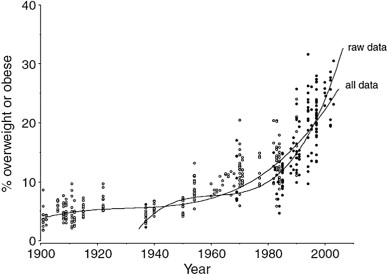
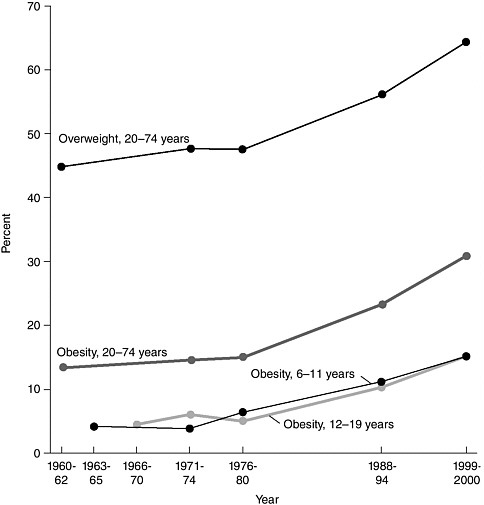
  • “Increases in childhood obesity rates may be partially attributed to decreases in the nutritional quality of diets “(Farris 275)
  • This increase in average weight of Americans can be shown overtime, historically. This correlates to school lunch health because it is one of the biggest, or biggest meals of the day for students.Also, making healthy food choices when one is young makes it easier to do throughout one’s life. 
  • Malnutrition, goes further than just weight and physical issues, as Laird says it can also damage children’s brains and affect their behavior and intelligence (24).

Safety/ Sanitization:

  • Another aspect of whether food is healthy is if it is safely prepared. Many things can go wrong in the kitchen that lead to food poisoning, like not cooking meat properly. However, bringing a packed lunch adds safety problems because food can spoil from the time it is packed to when it is eaten, hours later. 
  • Also, Park explains that lunch boxes should be sanitized daily in order for them to be clean and safe to keep food in (10).
  • Park says, “The cold lunch which a child has to carry to school should be planned with more, instead of less, care than the other two meals of the day, as there are a limited number of foods which are appetizing after having been packed for four hours ”(7). She explains how if food is not kept properly it can go bad and not be appetizing, or healthy to eat. 
  • The importance of sanitation has changed a lot in the past century due to things like technology improvement, like the increase of domestic refrigerators and freezers. Although these were available since the 1930s, suburbanization in the 1950s caused a skyrocket of these being available in the home. That made it easier to shop for food to pack in lunches and then store it safely (Bjornlund 78).

How the definition of healthy food  has changed:

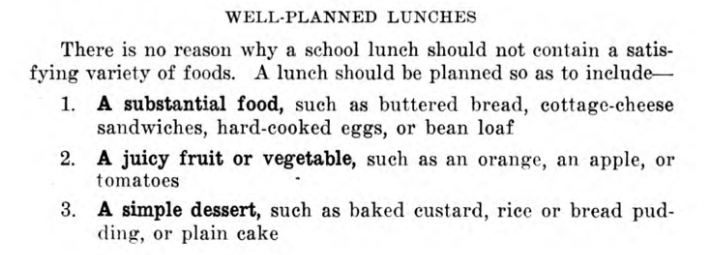
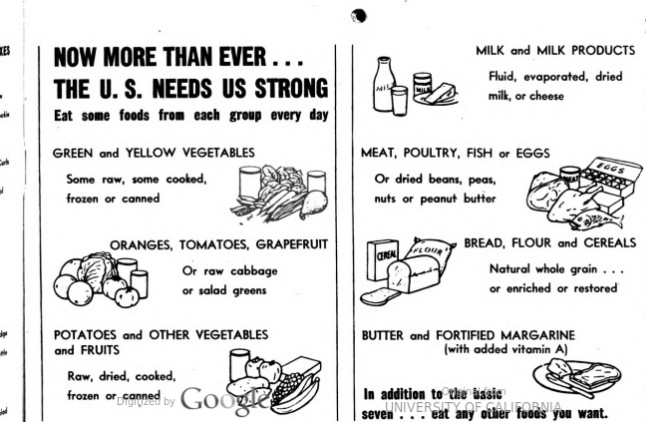
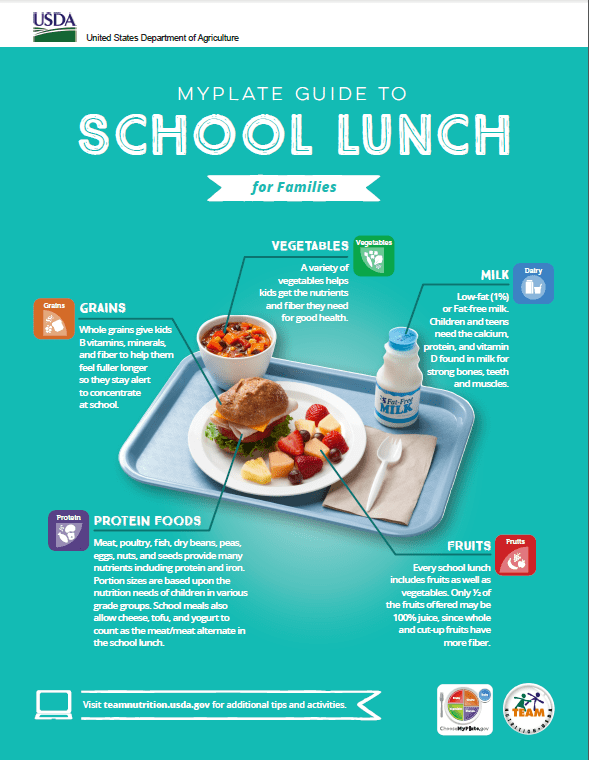
  • Throughout history, what people consider healthy has changed with more research  and improvements in technology. In Park’s book there were3 food groups, that she urged lunch packers to include, and in Buchholtz’s there were 7. Now there are various understandings of what is healthy and not much of a scientific consensus. However, the NLSP has 5 groups for school provided lunches.
  • Part of why definitions of what is healthy has changed in because of the rise industry marketing to build consumer want. Now, the dairy industry will emphasize the importance of dairy in a diet to sell their products.

1920s

1940s

NSLP Groups

Cost efficiency:

The cost of bringing one’s own lunch to school can vary greatly based on location. Also, free or reduced lunch programs make it more appealing for low-income families not to pack lunches. Nonetheless, packing a lunch can be more cost efficient if a lot of effort and time is put into it.

Comparing Cost of School Provided  Lunch vs Packed Lunch:

  • Caruso and Cullen Study Findings (89):
    • average cost of packed lunches was greater for elementary students ($1.93) than for intermediate students ($1.76) and ranged from $0.69 to $4.78 for elementary and $0.63 to $3.91 for intermediate school students
    • student cost for full-priced lunch was $1.80 for elementary and $2.05 for intermediate school student
    • the average lunch from home for elementary school students cost more than the school provided meal
    • However, purchasing al-la-carte items from school is much more expensive, with the least expensive item being 60 cents
  • This shows that it depends on may factors whether what type of school lunch is more cost effective or not. It depends on how the family goes about choosing what to buy in school lunches and could depend on whether there was a sale on bread at the grocery store one day or not. 
  • Bringing lunch can cost more because families may buy bigger brand names, which tend to be more expensive. The want for a certain brand name is fueled by consumerism in America. However, to save money on packed lunches, smart shopper can by store brand items, or search for good deals, if they put effort into being cost effcient.
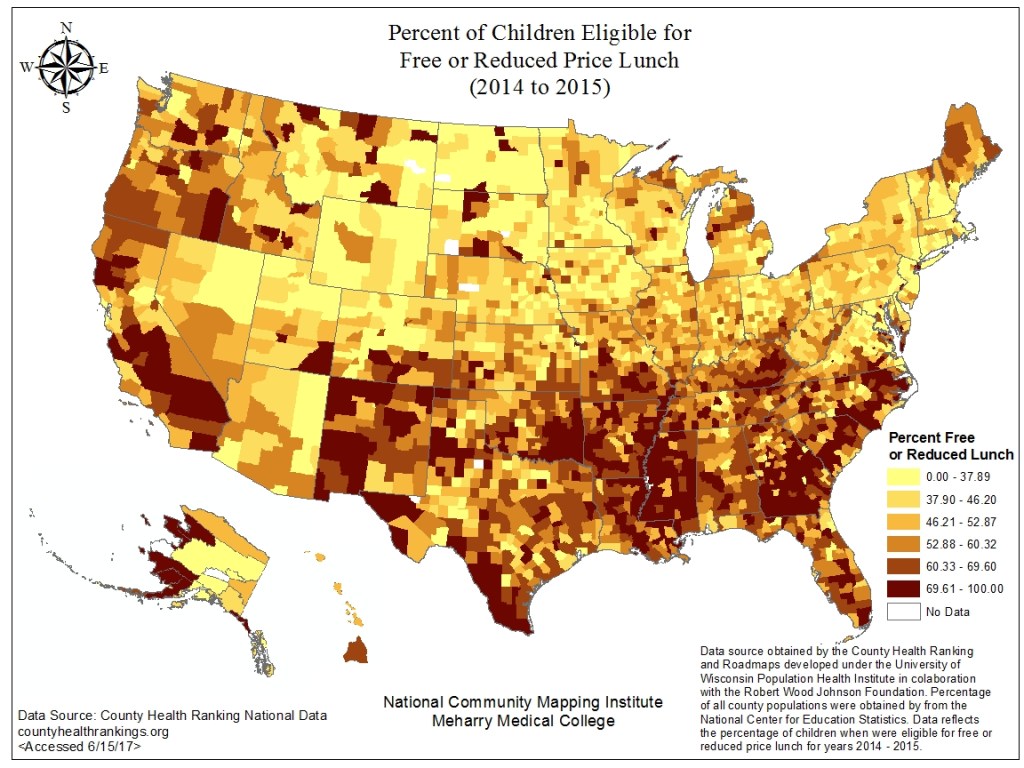
  • The prices of school lunch also can greatly vary based on areas. In the suburbs it tends to be higher because families spend more in taxes, so lunches are more heavily subsidized than in poorer, inner city locations (Poppendieck 188). This is the opposite of how it should be.
  • However, this doesn’t take into account students receiving free or reduced lunch

Free and Reduced lunch

  • The National School Lunch Act has made it so kids who are deemed to not be able to afford lunch can get it for free or reduced (Poppendick 59). This makes it so poorer families are more likely to not pack their children lunch because they know they can get it for free.
  • However Poppendick explains that on the daily schools see kids without 30 cents to buy even reduced  lunch (252)
  • This could be caused by more than just the family being too poor. It may be because they just do not have cash for students laying around, so Poppendieck suggest to eliminate the need for school lunch money- suggesting it could be a credit system (216)
  • This also solves other problems with lunch money or bringing lunch related to bullies or misplacing it (Poppendieck 216)

Methods:

Historical analysis: I compare how the differences and progression of how bringing school lunch has changed in the last century, in multiple of the topics discussed. I reference the changing genre roles associated with school lunch along with the changing health standards. These are able to be seen by using multiple sources that are from difference times in the past 100 years.

Fieldwork: I preformed a survey at my previous high school, and surrounding ones in my district, asking questions regarding all the topics covered to see how applicable it was to high school students . I chose to do high school, because most of the studies I found online focused on elementary and middle school.The suits of this are at the end on the blog.

2 Key Terms

Consumerism: encourages the consumption of material goods and the belief that it directly linked to one’s happiness. Influenced by advertising and branding to make one think obtaining certain goods and services will benefit them. Sky-rocked after World War 2 when people began to have disposable income and began to spend it on extra goods to show wealth.

This relates to bringing school lunch because the food in students lunches are examples of goods being consumed. Yes, people need food to survive, but the types of food and the brands associated with them make a difference. Also, the actual lunch boxes and bags being uses to bring school lunches to school are part of consumer culture. Bringing your own lunch has become a stereotypical display of wealth for students. This is because it shows they are able to afford packing a lunch and are probably not eligible to receive free or reduced lunch.

Suburbia: the reaction to the decaying city; fueled by white flight of middle class moving from the dirty, unsafe, and poor inner-city to the suburbs. The massive movement from out of the city also took place after World War 2 when the nation was having an economic boom. It was based on materialism and public acts of displaying wealth, through newer, bigger houses and everything that goes inside them.

This term also relates to school lunch. After World War II, when suburbanization occured, women’s role in the home changed. Less of them worked the jobs they did during the war and returned to the home to be housewives. One common responsibility would be preparing lunch for their children to bring to school. This has carried through even today. The suburbs have also made a difference on the type of school lunch provided for students at school. When a school district has more students living in the middle-class suburbs, more students are likely to bring their lunch because they can afford it.

These will both be referenced throughout the blog.

Design a site like this with WordPress.com
Get started